“That's Around the Time I Stopped Following You”

This morning, I read an article by Nick Kasmik on Substack titled, “don't ruin your beautiful soul to fit in an ugly society.” I have been following his writing for quite some time, and before then, watching his videos on Instagram where he elaborates on ancient and modern philosophy and how it applies to life.
What I appreciate about Nick’s writing and videos is that he makes things easy to understand. He is well-read enough to take challenging philosophical texts, and do a fantastic job of bringing to light ideas that may have been written hundreds of years ago, yet applying them to our current reality.
In what was a very personal essay published this morning, he shared about the importance of not getting caught up in social expectations for how most of us are expected to behave in society.
For many of us, myself included, that may mean we are acting in ways that follow the social order and don’t raise any red flags because we’re not pushing boundaries — challenging how things are supposed to be, or disrupting norms. The problem is, that if we only live within that framework, there is no spark for creativity. Instead, what lives within that way of existing is what the status quo expects of you. What more often results from that enforced conformity is anger, frustration, and rage. These become the dominant reaction, rather than the ability to step back, notice, ask questions, or be curious.
Something else I read from Kasmik this week — “you become what you fight” — suggests how important it is to notice the dominant way in which you’re reacting to the events of the world. If you’re constantly reacting with anger or frustration, it risks becoming your default behaviour — not just as a reaction, but in how you regularly see the world.
“Everything you choose to focus your attention upon simultaneously shapes who you are as you observe. You think you’re simply observing the darkness, but, conversely, the darkness has been studying you.”
Anger and rage are a challenge for me. I realize I tend to watch too many videos and read news that fall within the category of homophobia, transphobia, human rights issues, the genocide that Israel is committing against Palestinians…and the list goes on.
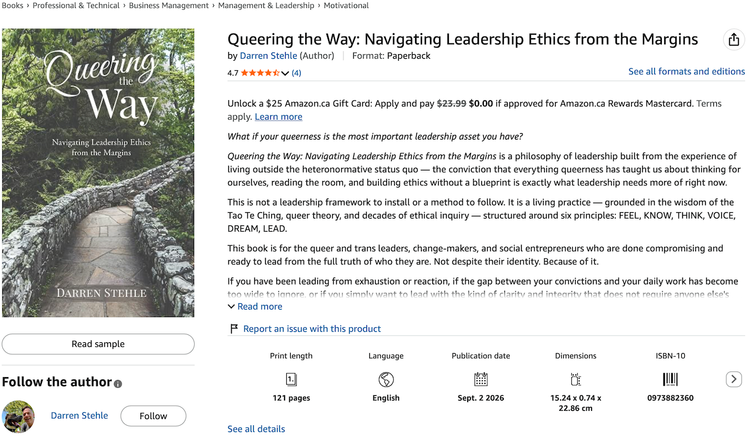
In my book Queering the Way, I tell the story of a former client who said something to me that forced me awake. Around early 2025, when I was watching the inauguration of the American president and processing what that meant, it was easy to be upset, react, and add fuel to a fire that was already burning red hot — which is exactly what I was doing in my content. They weren’t unkind. They said it the way you tell a friend the truth: “That's around the time I stopped following what you were writing.”
I thought to myself: Yes, I would have unfollowed myself.
However, I simply cannot ignore these world events, but I also can’t let them dominate my feed — or more importantly, my emotional and mental state. Like anyone else, I have to find a balance towards peace of mind, even when it seems increasingly difficult.
It reminds me of a Taoist quote from Chuang-Tzu (also known as Zhuangzi) on how one attains equanimity by following the Tao:
“Tranquility in disturbance means perfection.”
My question to you is borne of my curiosity:
How do you find balance or equanimity with whatever it is that most bothers you about what’s happening in the world?
Or perhaps this:
What strategies or reframes do you use to effectively embrace who you are and lead with greater certainty and confidence as a queer person?
There’s a bigger reason for why I posed those questions, one that’s based in possibly one of the most well-known psychological statements of all time:
Know thyself.
For what interests me — and I hope it interests you as well — is that humane leadership starts with knowing yourself. Specifically, making a meaningful difference towards improving the world and the lives of others depends on starting with the things that will absolutely change the trajectory of your life for the better.
When we don't do that work, the result is often anger or rage: if we're reactive all the time — and I'm implicating myself in this — we’re only going to beget more anger in ourselves and others.
However, in this case, the opposite of anger is not happiness. Here’s what I mean. If we’re happy all the time, I don’t believe that’s going to result in less anger. Instead, if we want to decrease the amount of reactive anger and polarization, we require a collective approach to everything we do that starts with how we treat other people. That involves things like respect, humility, compassion, and impartiality.
And the more that all of us get to experience those humane qualities, the better off we will all be.



Member discussion