I Wish We Didn't Have to Deal With All This

For almost two months, I didn’t know how to respond to what has been happening in the world, and in particular, the increase in discrimination and violence against 2SLGBTQIA+ people.
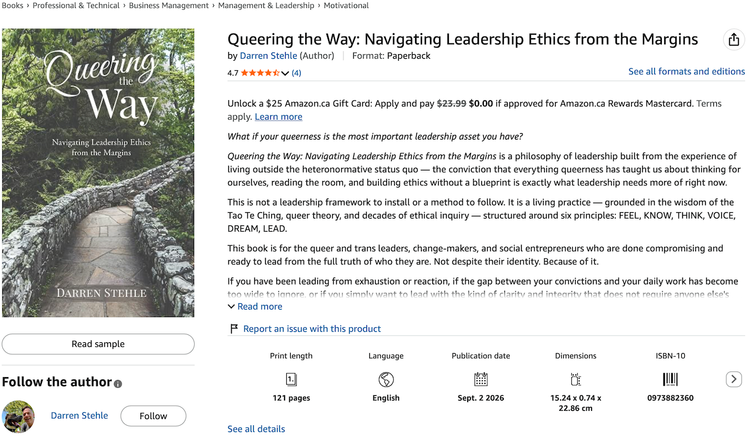
Just over a week ago, I published an excerpt from my book Queering the Way. It felt like the closest language to express what I wanted to say, when I didn’t yet have the clarity to create something new. Sharing what exists within the pages of my book allowed me to feel like I was making my way back to communicating my message with the least amount of resistance. Ironically, the chapter that I published is titled, “The Slow Work of Reasonableness.” (1) That is precisely how we can effectively deal with resistance in all of its manifestations.
I've been telling myself there's a good reason for why it took me about 7-weeks to publish something “new,” but “good,” at least to me, implies there was a justifiable and logical reason — like perhaps, “I’ve been so busy in my role as Director of Development at a national charitable foundation that I didn’t have the bandwidth to do any creative writing. At least the busy part of that story is true.
The truth, however, is messier: I've been stuck, obsessing over how to write about what's happening in the world without becoming the version of myself I would rather not be — someone who can be caustic, reactive, and labelling, which only adds another log to a fire that's already burning red-hot.
Recently, I haven't been able to stop thinking about the distinction between our positive and negative freedom (2).
This is a crucial distinction for understanding our human rights as 2SLGBTQIA+ peoples.
Most people either confuse these two forms of freedom or focus only on one, neglecting the other — and that misunderstanding affects everything from politics to personal behaviour.
What’s rattling the animals in the cage of my mind right now is what’s happening in Turkey. Uncloseted Media reported that on Sunday, September 13, 2026,
“Turkish police raided a variety of LGBTQ organizations and arrested at least 63 people. The targets included a gay bar, an LGBTQ advocacy organization and the founders of an HIV health association. That same day, the country’s Justice Minister, Akin Gurlek, said that prosecutors had launched an investigation into 162 suspects, nine associations and 13 businesses to “protect children, the institution of the family, and public order.” (3)
This isn't an isolated incident — and I don't have to be the one making that case.
Just over a week after the raids, the UN's High Commissioner for Human Rights, Volker Türk, spoke at the General Assembly. He labeled what's happening across dozens of countries as a coordinated campaign, not a string of unrelated events. He described the attacks as reaching into the physical, psychological, social, political, and legal dimensions of queer life at once.
“These attacks are designed to confuse and to distract. They cloak bigotry in the language of decency and morality. They invoke the protection of children against manufactured threats, while real and growing dangers to children’s lives and futures – including those linked to technology, inequality, and the climate disaster – remain unaddressed. So, there’s a big irony in all of this.” (4)
Using words like family, tradition, and child protection is a tactic to make exclusion sound virtuous instead of cruel. This is also an example rooted in the idea of “freedom from” something — in this case, freedom from those devious, evil queers.
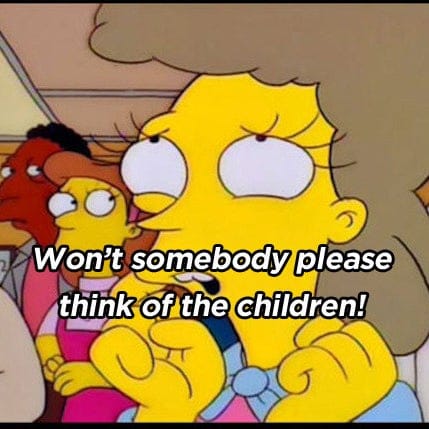
The irony is that many queer and trans people want absolutely nothing to do with children, their families, or tradition precisely because those systems excluded us, hurt us emotionally or physically, or killed us.
For those who do want children and families, it’s because they want to enjoy positive freedom. Namely, they aim to raise their kids in a way that allows them to flourish, make their own decisions, and allow them to express themselves in whatever way feels natural.
The strategy — by design — has been repeatedly played out generation after generation. The only thing different is the primary target. Currently, 2SLGBTQIA+ people are described as a threat that decent people should be protected from, yet concrete evidence is never provided to substantiate the threat.
Concurrently, we are witnessing a rollback of health and legal protections, censoring of queer and trans history, library bans of queer books, cutbacks to public forms of queer visibility on TV shows and in movies — because artistic expression in its greatest manifestation challenges conventions. The strategy behind reducing our visibility is deliberate: less visibility produces less familiarity, which produces less acceptance, which produces more violence against the “other” and what’s considered unacceptable social behaviour.
That's not a side effect. That's by design — to confuse and to distract — as Volker Türk put it.
Coming back to my animal instinct to react to news like this, I wrote about this aspect of myself in my book:
“It’s too easy to sound shrill and reactive, which I have done in the past. For the difference I want to make, I need to regulate my reactions and keep them to myself . . . I don't need to dump my emotional challenges and reactivity in an article when my goal is to improve the well-being and self-mastery of others.”
That resolve is being tested right now. There's a real desire in me to name exactly who's responsible for what's happening in Turkey, and why they're wrong, and crafting an argument you'd agree with. What’s harder, is what I’m doing in this very moment: being honest and transparent about what I’m thinking and why, and following the path that queering leadership actually requires of me.
Here's something else that I believe strongly, which is also from my book: if you are openly queer and in a leadership position, you don't get to sit out this moment in history. Why? Because you need to realize that the following statements about your innate human dignity and value are true:
- Speaking up is NOT divisive.
- Naming injustice is NOT inflammatory.
- Demanding equality is NOT a form of aggression.
- Not tolerating intolerance is NOT being intolerant.
- Refusing to disappear is NOT an imposition on any other person.
The opposites of those statements are false claims meant to keep you well-managed, obedient, palatable, silent, and unseen. That’s not a humane existence or one that any queer person deserves to accept as normal.
So the question I’ve been pondering (and fretting over) isn't whether to speak. It's how to speak up — and speak out — without confusing volume for courage.
You don't have to be the person holding a sign at a protest, or the loudest voice in the comments, to be doing the work. I'm not built for the streets — I know this about myself. I'm an armchair philosopher with a double espresso, a fountain pen, and 20 well-worn translations of the Tao Te Ching. For a long time, I felt a little embarrassed about that, like it was a lesser form of showing up. It isn't.
Some people are built to face the police and counter-protestors in the street. Others are built to fundraise, to mentor, or to support one person and help them find their footing. Each of these undertakings is a form of leadership because it sets an example and inspires others to follow your lead, or cultivate the combined activism of others.
Indifference is the sole genuine failure when facing injustice — not the shape your courage requires.
If we are worried about making others uncomfortable by simply being who we are as queer people, we give away our power, our sovereignty, and our positive freedom to express ourselves, pursue purpose, and act upon our values.
Many queer people unknowingly follow a map of which spaces they can be fully themselves in, and which ones they can't.
Turkey demonstrated that it has its own map, and it just reminded us of how quickly the borders can move and shift — and not in our favour.
So the question I want to leave you with isn't about Turkey, any other state, or oligarchs attacking queer and trans lives. Instead, it's about your map of where you find yourself — now. When you're deciding how to respond to what's happening in the world, are you,
- Complacent, or apathetic
- Anxious, depressed, or fearful
- Frozen, stuck, uncertain, or acting like nothing matters
- Frustrated, angry, or fucking livid
- Or are you managing yourself to respond reasonably?
Please understand that options 1 to 4 are all valid human experiences.
The point I’m making is the importance and necessity for collective self-mastery and well-being so that we can respond effectively and reasonably to these injustices. And by reasonable, I don’t mean making things comfortable, palatable, or making concessions that compromise our innate rights and dignity.
Our human rights and freedoms are no less and no more than anyone else’s. The challenge we all face is that justice is not an equally balanced formula; it’s a balancing act that requires moral courage, honesty, and the willingness to sit with periods of what feels like inequity while striving for parity.
This is a core practice of queer leadership: a non-performative response that resists being othered and excluded, yet finds acceptance and belonging in communities of like-hearts and minds which demonstrate dignity and humane virtue.
Your voice — unique, queer, and shaped by everything you have experienced and overcome — is not optional.
The world has spent a long time telling you to edit it, soften it, make it safe for people who were never going to be safe for you, or to just shut the hell up. You learned to comply. You learned so well that compliance became invisible, even to yourself.
Part of the work of queer leadership is to make that unconscious silencing audible again, and then to discover new ways to courageously speak your truth with clarity and conviction.
Having the courage to speak up is not always easy.
Alternatively, you could gradually diminish your leadership until it becomes ineffective and powerless. A queer voice that has made itself acceptable to the status quo has, in that exact measure, stopped being queer.
If what you've read here resonates — if you're curious what your own map looks like right now, and what's been stealthily redrawing its borders — I'd love to hear from you.



Member discussion