When “Sincerely Held Religious Beliefs” Becomes a Shield for Discrimination

In 2019, I read the news that the Texas Senate gave its initial approval to a bill that would let doctors, child care workers, and counsellors refuse service to LGBTQ people, so long as they could point to “a sincerely held religious belief.”
When I first wrote about it, my article was primarily an angry response. I'm returning to it now for a different reason: on July 18, 2026, Canada's Combatting Hate Act — Bill C-9 — became enforceable law, and the objections to it (primarily from the Conservative Party of Canada) ran on the same logic as the Texas bill, inverted. In Texas, “sincerely held religious belief” was the ask — a request for permission to discriminate. In Canada, it was the complaint — an argument that removing a legal shield for that kind of speech amounted to discriminating against believers.
Many religious conservatives in Canada treated the loss of a license to discriminate as discrimination against them.
Bill C-9 does several things. It creates a standalone hate crime offence. It makes it a crime to block someone's access to a place of worship, a school, or a community centre. Furthermore, it adds a legal definition of hatred. None of that drew sustained opposition from the Conservative benches in Parliament. What did was the removal of a narrow exemption that had shielded people who, “in good faith,” expressed an opinion on a religious subject from prosecution under hate speech law.
I believe this suggests something worth exploring, not just within Canadian law, but also in how many of us—queer, straight, religious, or secular—construct and justify our own ethical frameworks.
What the Exemption Actually Protected, and What it Didn’t
My friend Wilbur Turner wrote about this recently, and he explained something that many people don’t fully understand: Canadian courts had already drawn this line, years before C-9 existed. In the 2013 Supreme Court case Saskatchewan v. Whatcott, the court found that citing a religious text is, on its own, almost never hate speech. What crossed the line wasn't scripture. It was the language wrapped around it.
Scripture rarely says what people claim it says outright; it gets interpreted, extended, and often quietly rewritten to carry a prejudice the text itself never stated — in that case, describing 2SLGBTQIA+ people as diseased and predatory.
As Wilbur put it, the court found that language amounted to “detestation and vilification rather than participation in public debate.”
I find that distinction necessary and clarifying — it means a belief and a person's conduct toward someone else are two separate things. You can hold a belief in sincerity — inherited and unquestioned for decades — and still be responsible for what you do with it when another human being is standing in front of you.
Belief — What you hold to be true, whether you keep it to yourself or preach it from a pulpit.
Conduct — What you do to another person because of it.
The first — belief — is yours. Canadian courts, and most functioning ethical systems, protect it fiercely. The second stops being only yours the moment it touches someone else's freedom, safety, or dignity — and that is precisely the point at which "sincerely held" stops functioning as a defence.
A belief and a person’s conduct toward someone else are two separate things.
Sincerity Was Never the Question
Here is what I think the “sincerely held religious belief” framing is actually doing, whether the people using it realize it or not: it's asking us to evaluate the wrong variable. It invites us to ask how deeply do you believe this? — as though depth of conviction were a measure of its rightness. Yet depth of conviction has never been evidence of harmlessness. Some of the most sincerely held beliefs in human history have done the most damage.
Sincerity tells you something about the believer's inner state — it tells you nothing about the effect on the person standing across from them.
One’s depth of conviction is not a measure of its ethical rightness.
In terms of leadership, this is the same failure I sometimes see in leaders who mistake the strength of their conviction for the rightness of their direction.
Certainty is not a form of ethics. It's a feeling. And a feeling, however sincerely held, doesn't get to override another person's right to exist, marry, worship, parent, or walk into a school without being refused entry at the door.
A Better Question to Ask
I don't think the answer here is to dismiss religious belief, or to re-litigate whether religion itself does more harm than good — that's a different piece, for a different day. Many people I coach and admire hold faith and queerness together, sometimes effortlessly, and sometimes at a significant personal cost. I’m not interested in telling them their beliefs are the problem.
What I am interested in is this:
What would it look like if, every time someone claimed “sincerely held religious belief” to justify an action toward another person, we asked a transformational question — not how sincere is this?, but rather who is affected by this action, and what harm does it cause them?
That question doesn't require anyone to abandon their faith. It just asks the believer to answer for the consequences of their conduct — in the same way, we ask everything else that claims moral authority to answer for its consequences.
So, I'll leave you with the same question I'm contemplating:
If a belief can only exist by taking away someone else's dignity, freedom, or humanity, what does that tell you about the belief — and what does it ask of you?
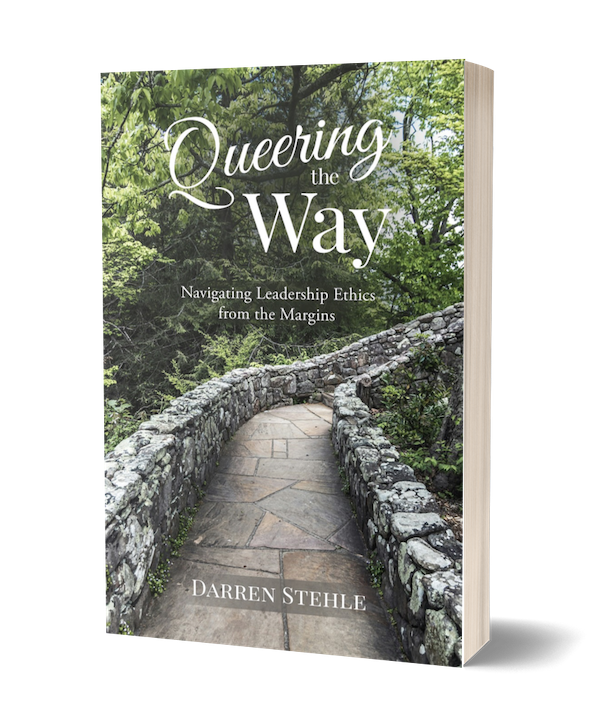
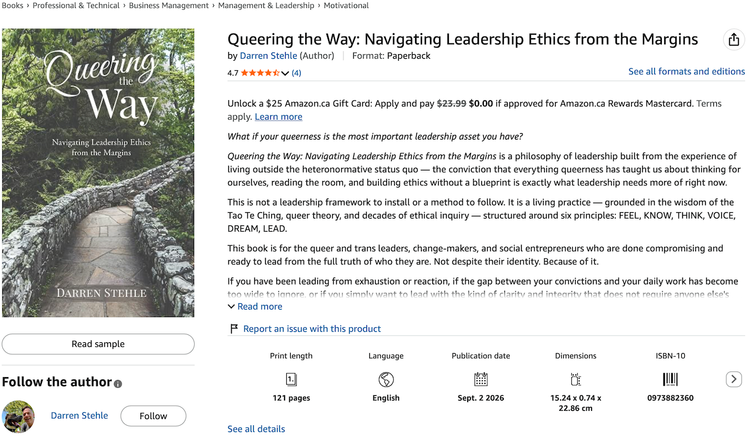
If this question speaks to you, in my book, Queering the Way: Navigating Leadership Ethics from the Margins, I present six principles that work through this ethical terrain — what we believe, how we act on it, and how to lead from integrity rather than conformity.




Member discussion