The Slow Work of Reasonableness

Are you finding it challenging to think clearly at the moment?
What I mean is, with everything that's going on in the world, I know I am challenged by thinking, rationally, but more importantly, thinking with an open heart and open mind.
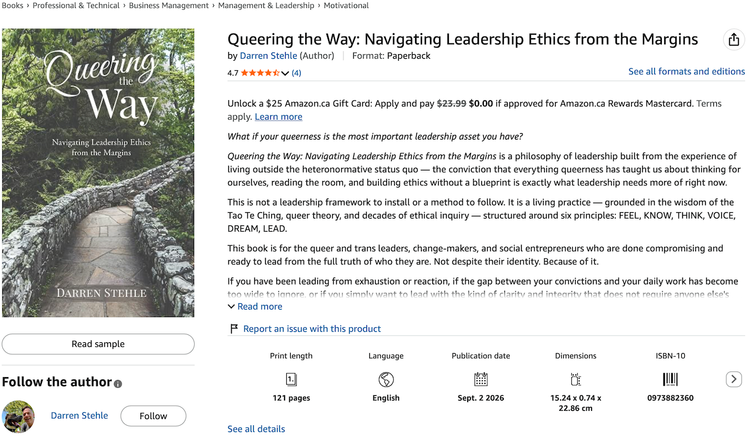
If we want to work together and work towards resolving differences and inspire leadership that recognizes human dignity, we need to take the time to think before we respond. This is why I'm sharing an excerpt from my book Queering the Way: Navigating Leadership Ethics from the Margins. In the section, “The 3rd Principle — THINK: Open Heart, Open Mind,” I write about what often presents as a difficult challenge, namely, that behaving reasonably is so much slower than reactivity. However, that's not a character flaw.
It's human nature to defend and protect what we think is right — even when the belief that we are right (or have the right) could be nothing more than righteousness.
Enjoy the excerpt.
The Slow Work of Reasonableness
Think about the last time you lost your cool and flew off the handle. How long did it take to regain a calm state of mind where you could think critically, analyzing and evaluating the situation fairly and logically to create a practical and measured response?
For most people, the honest answer is: longer than they’d like to admit. This is the category in which I — still too often — find myself.
When we are anxious, overwhelmed, or stressed — when we don’t feel safe, secure, or accepted — we shift into defensive, reactive mode. The amygdala kicks in, triggering a fight, flight, or freeze response. This is not a character flaw. It is a neurological fact. If the perceived threat is social or tied to our identity, such as prejudice or rejection, the emotional mammalian part of our brain takes control. In either case, the logical part of our brain (the prefrontal cortex) is hijacked. Until we feel safe and secure, our capacity for critical thinking is either limited or entirely shut down.
This is the fundamental challenge with critical thinking: it is slow. It takes time to think rationally, reasonably, and empathically before choosing a measured response or course of action. Paradoxically, we live in a world that glorifies brevity and expediency, designed to make that slowness feel intolerable.
This is the very real and human problem we collectively face: a capitalist world that demands speed, and an internet world that prioritizes quick hits of outrage or dopamine hits. Both of those are contrary to slow, measured, and reasoned thinking.
The expression level heads prevail is a useful reminder. Having a level head means you are metaphorically in your mind instead of outside of it, able to access your logical reasoning and make careful choices about how to respond, having pre-empted the fight-flight-freeze reaction for a calm, logical, and reasonable response.
This is the crux of reasonableness. It’s terribly slow. (I know, I keep repeating this point.)
It takes more time to think calmly, clearly, and logically than it does to have a knee-jerk emotional reaction. Being reasonable requires patience and practice, not just in how effectively one reasons, but in how efficiently one can catch themselves before crossing the red line into extreme emotional reactivity.
When you are out of your mind, everything seems to require an immediate response.
- Something must be done!
- Why isn’t anyone doing anything about this!
- I can’t believe this is happening!
Hyperbole, declarative statements, overly general categorizations, and false logic dominate out-of-your-mind reactions. They are useless expressions, devoid of any productive change-making solutions.
I know this from personal experience. Not long ago, I wrote an angry email response to someone who had irritated me. A small slip, but a slip nonetheless. Was I right? I had a point, but I could have expressed my frustrations better with a well-reasoned response that would have improved my chance of changing the other person’s mind. Either way, I would have felt calmer and wouldn’t have been annoyed about it for the rest of the day.
The danger with shouting and making declarations about right or wrong is that you push people further away from the possibility of shared understanding.
This is the basic law of resistance: push someone and they will push back. Tell them they’re wrong, and they will likely hunker down even deeper to defend what they believe to be true. You cannot win an argument in a fight.
So how do you think in ways that are curious, flexible, humane, and logical?
What does your thinking look and feel like when it is normative, rigid, and uncompromising?
And what does it look like when it isn’t?


Member discussion