Queer Liberation Is Not Assimilation

“Queer leadership is rooted in the principle of individuals leading from their difference and creative uniqueness, not to assimilate into the dominant culture, but to liberate and elevate those oppressed by the status quo.”
In 2020, I published a free PDF download called Think Queerly: Meditations and Critical Reflections on Liberating Humanity. This was a collection of pull quotes from articles I had written between 2018 and 2020 on my former Medium publication, also called, Th-Ink Queerly.
At the time, not only was I publishing a couple of times per week, but I was also editing and publishing other authors on my publication. Being so absorbed and involved with queer thinking about politics, rights, freedoms, and advocacy gave birth to a question that has guided me towards where I find myself today:
“Is there such a thing as a queer leadership?”
Leading from Difference
Queer leadership isn't about organizing or managing people. It’s not a category in the same way that people will describe organizational leadership, C-Suite leadership, or nonprofit leadership. Instead, It's about leading from the margins — proudly and unequivocally without apology, from a unique perspective based in the perception of seeing social structures and systems from outside the status quo.
As much as heteronormative society would like for us to remain unseen and unheard – or at least palatable enough not to be disruptive. – the long duration of witnessing from the closet before we come out provides time for self-reflection, self-awareness, and a critical lens to question everything we’ve been taught.
My belief is that queer leadership is not about teaching or telling people how to lead. Instead, it’s about leading by example, from a stance of transparency and honesty (how else could you lead as a queer person having had to hide who you are for so long?) so that others are inspired to follow your lead — literally — but in their own way.
The Tao Te Ching says,
“The best leader works without being seen, helping all but known by few… When their subtle work is completed, their duty done, ordinary people say, “We did it ourselves.”
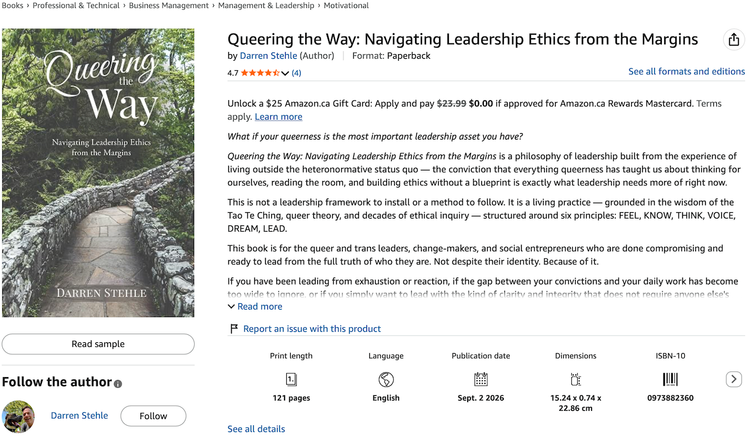
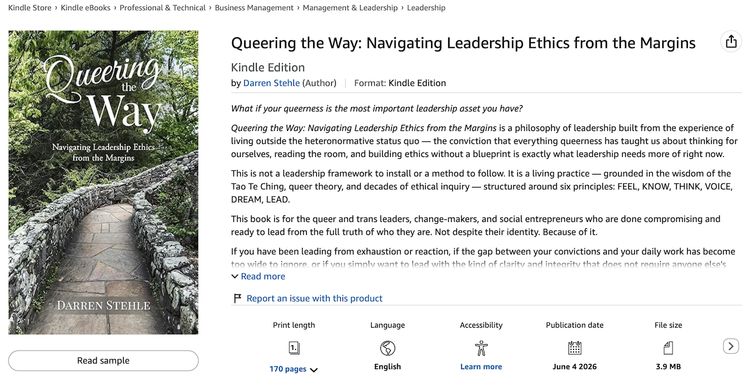
Certainly, at the time, I did not know if I could classify leadership as queer, or describe leadership through a queer lens when the leader openly identifies as such. This was intuition before this question and contemplation became a fully fleshed out structure in my book, Queering the Way: Navigating Leadership Ethics from the Margins.
I attempted to answer this question by pulling together about 20 articles I had written about queer leadership. It remains an unfinished draft of about 12,000 words, but those ideas, although immature and not very articulate, did not die on the page.
Six years later in 2026, it became the foundation of the sixth and final principle in Queering the Way: LEAD.
The principle LEAD is an acronym for Liberation. Equity. Accountability. Direction. For this article, I’m only going to dive into the first word — Liberation — because that directly references what I quoted at the beginning.
Here’s how I define Liberation within the framework of my LEAD principle:
“L – Liberation. Lead in ways that liberate yourself and others from systems of oppression, fear, or conformity. This is the heart of transformational leadership: expanding freedom through ethical courage.”
That’s great as an idea, but how do we make that concrete? How do we show up as queer leaders to expand our freedoms and respect for human dignity with ethical courage? How do we actually liberate ourselves and others from oppression?
In Queering the Way, I write,
“Leadership is not about position. It's about permission. As queer leaders, we have had to master giving ourselves permission our entire lives."
You can only give yourself permission once you realize you don’t have it.
In many ways, it’s much easier to liberate yourself as a queer person – to free yourself from the closet and to step out of the margins – than it has ever been in any other time in history. Is it any wonder that there is so much pushback from political and religious forces that are trying to limit the freedom with which people can observe lived queer experience that is represented in a dignified and humane way?
I remember, in my early teen years, struggling with trying to understand my identity and how I felt different from everyone else. I did not have a role model, nor did I see positive representation of gay men in the media. And I say the latter because queer and trans experience was not as broadly and diversely represented as it is now when I was growing up (I was born in 1965). But that’s not to say that when I was a kid, I had to walk 5 miles backwards, barefoot in the drifting snow to get to school, unlike the kids today who could take an Uber.
So, to be clear, I’m not saying it’s easy. If coming out was easy for you, you are fortunate, and I urge you to celebrate and recognize that. Because that kind of empowerment becomes a spark — a way of thinking that's genuinely transferable when you work to support the liberation of others. Alternatively, if you’re coming out was challenging, that can also be motivation to liberate others with care, compassion, and guidance.
Liberation is structural work at the social level of equity and justice. You can't liberate others from a position you haven't first claimed for yourself.
Giving ourselves the permission to lead, openly and authentically, with pride and without apology, is the bridge between personal and social liberation.
We can lead from the margins, but we don’t have to remain there. However, I caution queer leaders not to assimilate or to conform — that defeats the purpose of true liberation.
If there is one thing I have learned from trying to fit in, it is that conformity doesn’t work, because we're still perceived as different regardless, which makes us an even more convenient scapegoat for the right. We have enjoyed an increase in freedoms, protections, and rights over the last 50 years, and now we are seeing yet another rise in anti-2SLGBTQI+ hate using our existence and identities as scapegoats for all the ills of the world. When we try to fit in, we do not belong.
When we attempt to fit into hegemonic structures, we inevitably remain different — and those who've made a religion of the binary will always perceive our uniqueness through the squint of their own limitation. No amount of performance will satisfy those for whom the binary is the beginning and end of human understanding.
So instead, why the hell not embrace that uniqueness, that queerness, and refuse to compromise?
The Price of Ethical Courage
I don’t think I’ve ever articulated this idea of staying true to my queerness so clearly. The cost is experiential, and we can’t minimize it. Showing up as authentically queer — uncompromising and refusing to perform normatively for anyone's comfort — means accepting that you will be a target. Not just online or politically, but sometimes in places you assumed were safe. That is the price of ethical courage, and it is not evenly distributed.
We need the courage now, more than ever, not just to defend our rights and freedoms, but to drastically change hearts and minds.
This is not about convincing other people. This is about making people understand the limits of their thinking at the root level of why they believe queerness is wrong. Philosophically, I don’t believe there is a single justifiable or rational reason. From a critical thinking standpoint, you can’t convince me because anything anti-queer is anti-rational. And by that, it’s usually based in fundamentalist, religious thinking – and I would say thinking is too forgiving of a word in this context.
Queering the Conclusion?
I opened the article with a quote that I now wish to present as a question:
How can we lead from our difference and creative uniqueness, not to assimilate into the dominant culture, but to liberate and elevate those oppressed by the status quo?
I trust I have provided food for thought grounded in my principle, LEAD — specifically that Liberation is the essential first move: you cannot lead others toward freedom from a place you haven't yet claimed for yourself.
Queer rights are rooted in the public movements of the 1970s, with organizations taking names like, The Gay Liberation Front. They knew what kind of action was required over 50 years ago — in-your-face advocacy and social disruption. I believe that we need to return to that existential urgency — without compromise, without backing down, and without trying to conform.
Before I close, I invite you to answer one question,
What permission do I need to give myself first — for my own liberation — so that others will be inspired to also break free?
Providing more clarity and direction in your answer will significantly enhance your ability to inspire and liberate others to follow your lead.

Queering the Way: Navigating Leadership Ethics from the Margins is a book for queer leaders — and for anyone who has ever had to build their ethics from scratch — that shows you how to transform the hard-won wisdom of the margins into the kind of human-hearted leadership the world genuinely needs right now.
You can order the book directly from me and everywhere books are sold online including Amazon, Apple Books, and Kobo.



Member discussion